
Roche Axelios Pricing
We finally have pricing from Roche!
$150 per human genome (Duplex, 30x).
6 cents/M reads Simplex.
~$2400 per run (20 reuses).
Sensor module price “More than 1k, less than 16k”. Can be reused 20 times.
$750,000 Instrument price.
This pricing is competitive with Illumina, and everyone else1. But it isn’t aggressively low.
Illumina sold ~300 NovaSeq’s last year. I think I could see Roche selling perhaps 100 to 200 instruments in the first year, but not massively displacing Illumina.
Why Will It Do Better Than Ultima/Element?
This is in contrast to Ultima, who also sell a NovaSeq-class instrument. Who I estimated have placed 20 to 30 instruments. There are a few reasons why I think Roche will do better than Ultima:
It’s more interesting2, and will generate novel papers more easily than Ultima.
Roche isn’t going away. Unlike Ultima, who might run out of cash (adding risk for users).
It’s cheaper. While Roche focus on duplex costs. Many applications only require Simplex. For short Simplex reads the instrument can generate 40B reads for 9cents/million3. Compare that to Ultima who quote 24cents/million4. This will play in Roche’s favor for counting applications.
So, overall. Roche is lower risk, more interesting, and cheaper for some applications.
I also think it compares favorably to the new Element high-throughput box, for similar reasons.
I don’t think it kills Ultima (PPMSeq is neat) and Element (midrange5) completely on a technological basis.
But as these companies are struggling anyway, it could easily take enough of their market to make them non-viable companies.
On balance, it’s easy to see why Roche may do much better than Ultima/Element. And it’s difficult to see how Ultima/Element will remain competitive.
Why It Wont Kill Illumina (Today)
While it’s lower risk than Ultima and Element there are a few things that work against Roche.
Illumina is “safe”. Everybody is already using it, we know it’s robust at scale.
Some users will be worried about certain technical features and wait for others to try it first:
But the duplex reads have “N”s, how will that affect us?
But what about carry-over from chip reuse? They say it’s fine… is it really fine?
Will the higher error rate on simplex affect our counting application?
Moving from Illumina is “work”. It’s a very different data type. Pipelines may need significant reworking. Users with existing Illumina-based infrastructure, will likely continue to scale this in the short term.
It’s not much cheaper (duplex).
Why It Will Take Some Of Illumina’s Market
It’s novel.
It is faster.
It’s maybe a little cheaper (duplex).
It’s much cheaper (simplex) for counting applications.
Several larger (research) users will buy it for the novelty factor which will let them publish papers around this new technology. If these validation exercises pan out, they may commit more heavily.
There’s a lower probability that some large users will have seen enough to be convinced already and be willing to commit. If one large user commits, then others will likely follow. But, this likely takes years to play out. This isn’t like the transition to NGS, you can do the same science on a NovaSeq. It’s more of a pricing issue.
The Future/other factors
Roche have shown list pricing. This pricing is based on reusing the chip ~20 times. Throughput seems stable over uses:
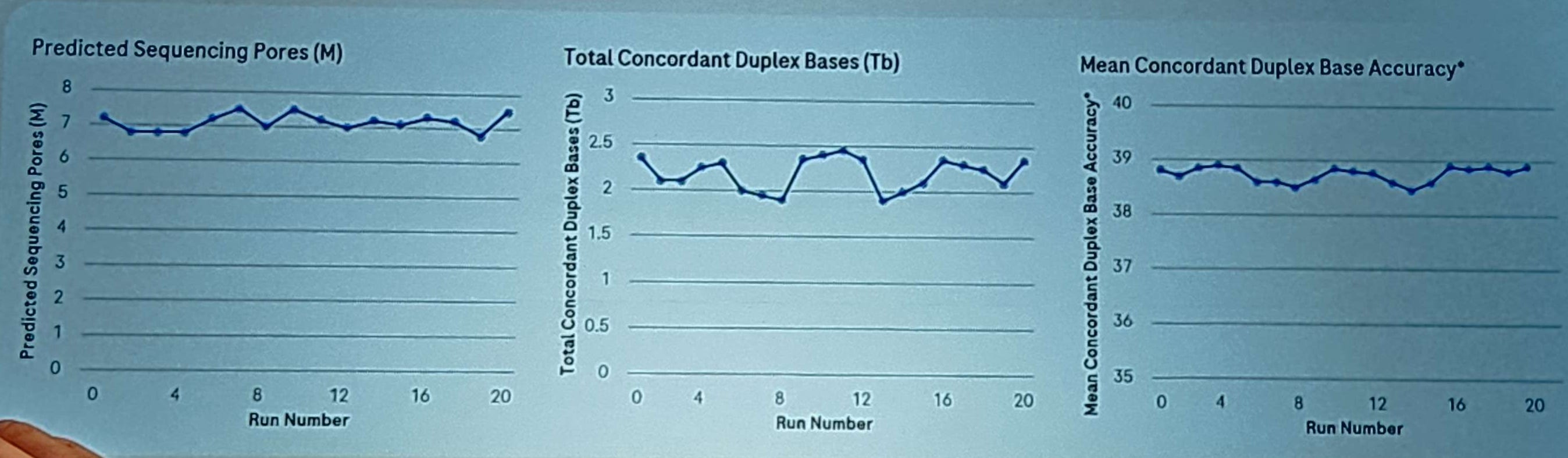
Over 16 chips, all but 1 could be reused 20 times. The sensor chip will ship with an above usage life time of 2 to 3 months.
What does this mean?
It means that chip cost isn’t really a factor in run pricing. I don’t think Roche chips cost much more than Ion Torrent. Putting them at <$1000. The per-run cost is likely <$50 of $2400 currently quoted.
Reagents may be a bigger factor. But while I don’t have good numbers here. I suspect at volume margins for Roche can be very high. The issue for them is that at current pricing the ramp to high volume may be slow.
So… if Roche want to, I think they can easily offer lower pricing. I suspect Roche just doesn’t believe current demand warrants this (no hyper-elastic growth).
They can however heavy discounts to large customers if they feel it’s worth it.
They can also have the potential to get much more aggressive on pricing in the future.
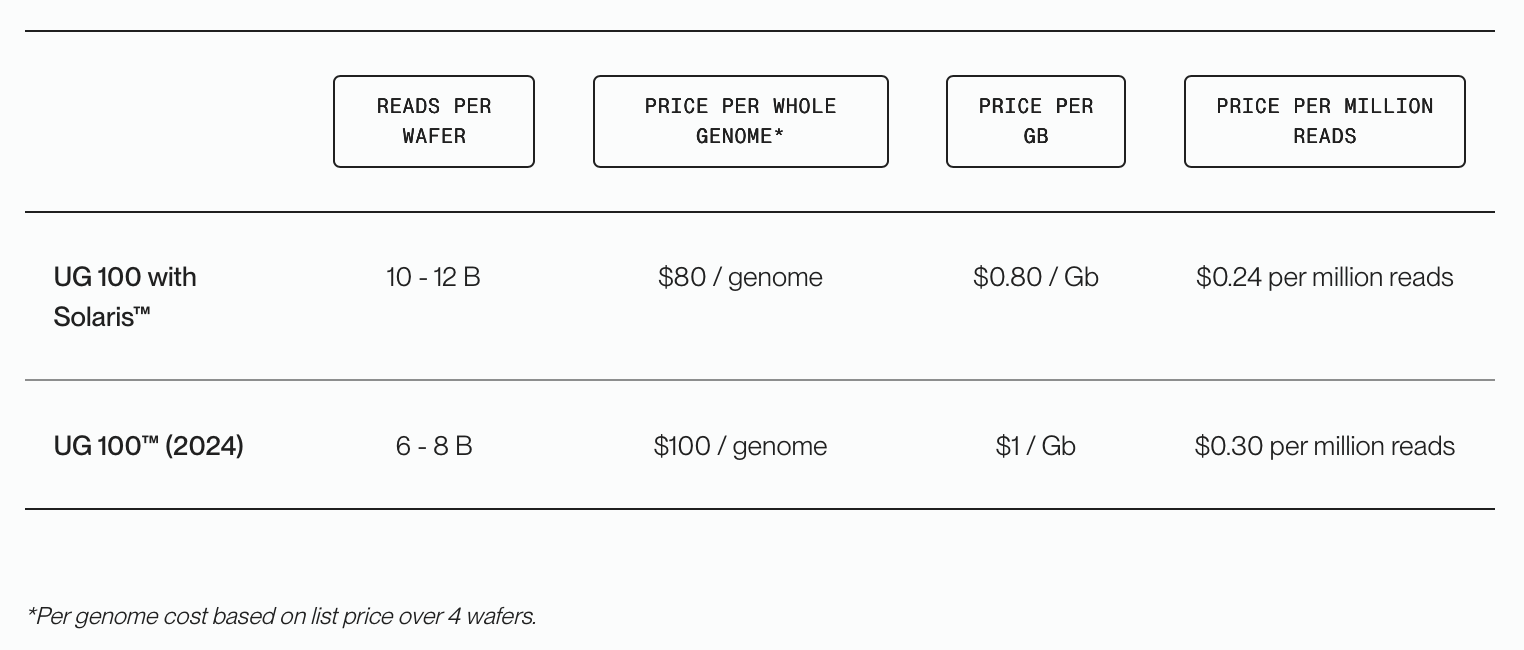
The lowest pricing announced would be $80 from Ultima. But in practice other costs may add to that. Anywhere in a $80 to $200 range for a 30x genome is ball park “market price” at this point.
Longer reads, more interesting read characteristics.
Via GenomeWeb: “According to Karlberg, simplex sequencing can “generate significantly more reads,” which can have different lengths. Using a 175 bp average read length as an example, the platform can generate around 40 billion reads in four hours of sequencing. In the case of a 500 bp average read length, it can produce 10 billion reads in four hours. The company is quoting $.06 per million reads for simplex sequencing.”
Element’s current instrument is $250K targeting the midrange where the Roche box doesn’t currently play. Element’s platform is more “Illumina”-like, this may make them an easier switch for some users.